The
Micro
Firm
The Atomic Unit of Ownership in an AI-Native Economy
For a century, the company was the smallest serious unit of the economy. Not the best of several options. The only one. That just stopped being true.
For most of modern economic history, the company was the smallest serious container for productive capacity.
Not because companies were sacred, but because an individual could not hold what serious production required. Coordination, memory, administration, trust, distribution, and execution were all too expensive to carry alone, so they had to be pooled. The structure that pooled them was the company. It was not the best of several options. For a long time, it was the only one.
That bargain is breaking. The functions that once required a company are becoming infrastructure, available on demand, below the scale of a company, to a person or a small group. When that happens, the floor drops. The smallest unit that can hold serious productive capacity stops being the company and becomes something smaller.
That smaller thing is the micro firm.
- a small business
- a scaled-down company
- a solo operation that has not grown yet
- a freelancer with better software
The smallest human-led ownership unit capable of running AI-native productive capacity.
- Persistent intelligence
- Governed orchestration
- Permissioned memory
- Trust rails
- Trusted networks
The word micro describes its human size, not its capacity. It can be small and still serious.
Three costs built the company. Three shifts are taking them apart.
Work no longer has to move through a hierarchy that carries every handoff on human shoulders.
Context no longer has to live inside individual human attention.
Proof, approval, permissions, and auditability can be built into the workflow itself.
A micro firm is what appears when coordination, memory, and trust no longer require a corporation to hold them.
The real test
The test of a micro firm is not whether it uses AI. That bar is too low. The real test is whether the firm can hold what used to overwhelm the owner.
- Remember customer context
- Run follow-up without being personally pushed
- Tell low-risk execution from high-trust decisions
- Show evidence before it acts
- Escalate what is ambiguous
- Learn from repeated work
- Coordinate across tools and providers
A micro firm begins when the operating burden moves out of the owner's head and into a governed system the owner controls. Responsibility no longer means personally carrying every open loop.
Who it is for
wrapping real expertise in a firm of their own.
that wants capability without headcount.
of an existing company who suspects the pyramid is the problem, not the people.
publisher, or provider shaping the ecosystem these firms will run on.
If you have ever felt that you are the operating system of your own business, this book is about what replaces you in that role, and what you become instead.
The Micro Firm is about the new unit of business in the AI-native economy: how one person, or a few, can own a productive system that holds its own memory, governs its own work, and compounds over time, instead of a business that depends on them for everything. It moves from the idea to the architecture to the network, in six parts.
Part IThe Reset
Every era of business has a unit. The workshop, the factory, the corporation, the platform. Each was the smallest structure that could hold the work of its time. This part names the unit of the AI-native era, the micro firm, and shows why the old advice to “become an entrepreneur” now walks capable people into a trap: they leave a company only to become one. Ownership, not entrepreneurship, is the position that matters now, and for the first time it fits in a few hands.
Part IIThe Operating Foundation
A firm that runs on its owner’s memory has a ceiling, and the ceiling is one person’s attention. This part builds the foundation that removes it: persistent intelligence that holds what the business knows, a set of governed brains that carry its judgment, and a memory layer that turns hard-won competency into property the firm owns. This is the engine that lets a firm compound instead of merely operate.
Part IIIThe Execution Layer
Here the unit runs whole. This part follows a single micro firm from end to end, from the first client decision to the money, and shows how work becomes a set of reliable runs rather than a pile of tasks in one head. It is where capability finally comes apart from headcount: a few people governing a system that produces what used to take a company.
Part IVThe Governing Layer
Scale without governance is only risk moving faster. This part builds the layer that keeps a growing firm honest: a single source of truth the whole system reads from, signal that turns raw activity into strategy, and a clear place for human judgment at the edge, where it decides rather than where it bottlenecks. Governance is what makes a firm’s growth durable, and what makes it worth backing.
Part VThe Network
A micro firm does not scale by swelling into a pyramid. It scales by connecting. This part shows how units compose across trust rails, how a proven way of working replicates without being cloned, and how an ecosystem of builders, providers, and networks forms around them. It is also where the deep claim lands: when trust becomes portable, the economics that once forced work inside large companies begin to run the other way.
Part VIThe Transition
The last part is the on-ramp. It names the trap most people fall into when they try to change everything at once, and lays out the disciplined path instead: start with one owned workflow, prove it, and compound from there. It closes with what the micro firm changes about work and capital, and what it means, now, to own the system rather than sell your time into someone else’s.
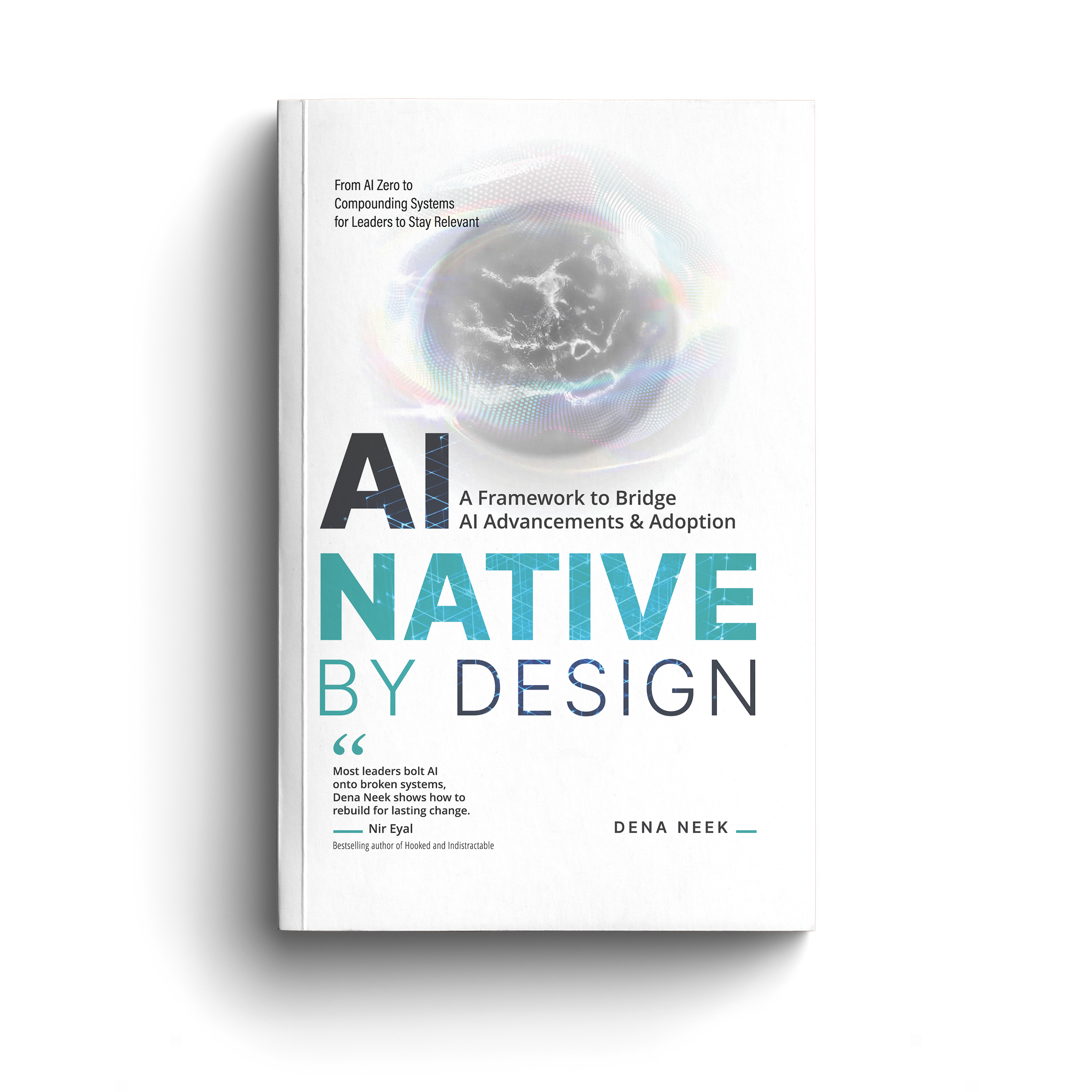
AI Native by Design redesigns the company you have. The Micro Firm builds the unit that comes next.
The first book closed with three questions it deliberately left open: who owns the micro firm and what ownership means, how its memory is governed so the firm can learn without leaking, and how micro firms connect into networks instead of scaling back into pyramids.
This book answers them.
Explore AI Native by DesignOne owner.
One system.
One capability.
The book releases July 31. Early readers get access before it's publicly available, along with a launch discount. Leave your name and email and we'll reach out.