

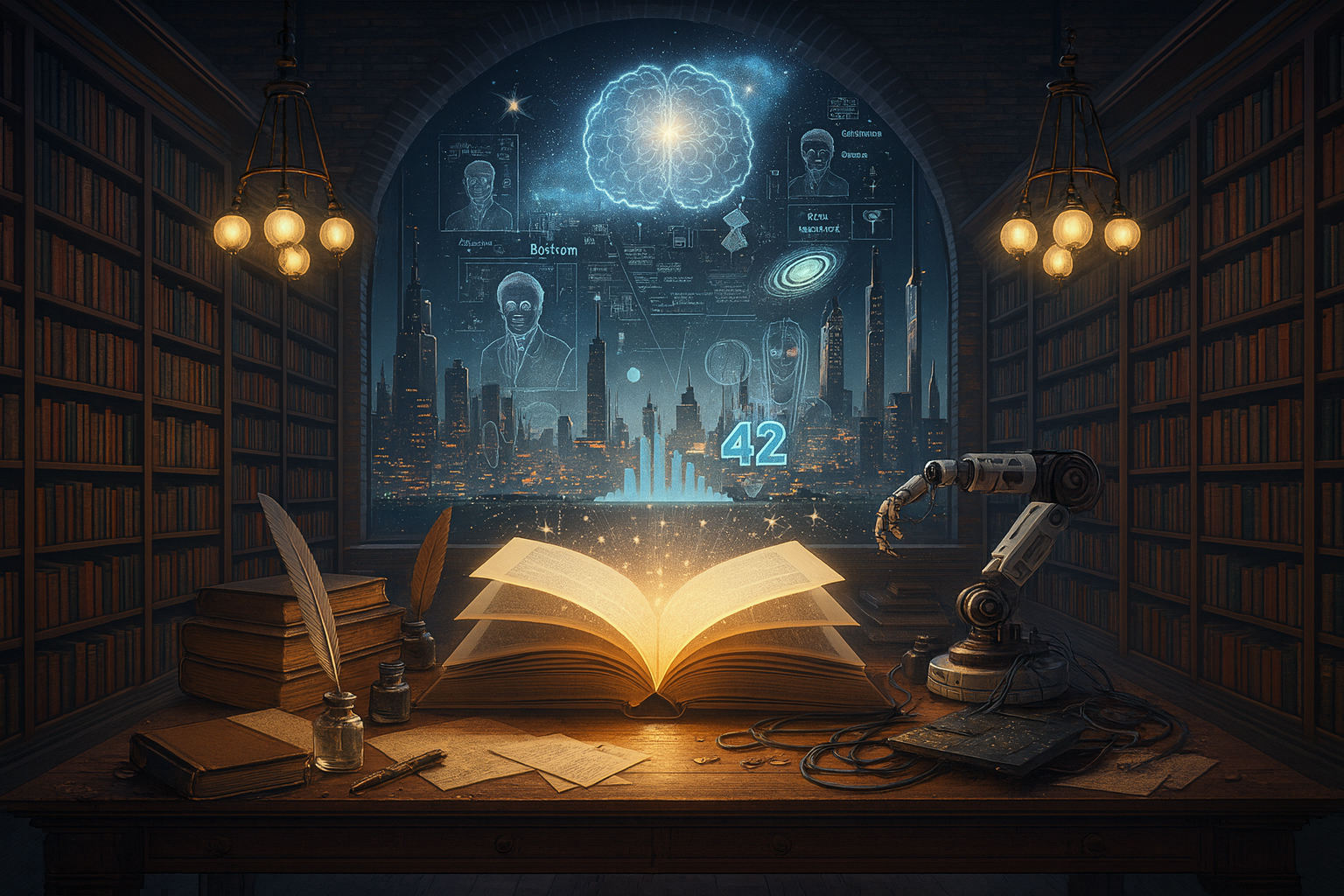
Every civilization imagines before it engineers.
We talk about AI as if it’s a new invention. It isn’t.
It’s an old story, one we’ve been writing for centuries.
Before we built machines that learned, we wrote stories about them. Before we ran code, we tested logic in imagination.
Science fiction has always been the R&D lab of civilization, a place where humanity prototypes itself without consequence.
Imagination as Infrastructure
Every AI model is a story trained into mathematics, a compressed narrative of how the world should behave. Every time we ask, “What happens if AI outthinks us?” or “What if society collapses under its own automation?”, we’re not fantasizing. We’re running cognitive simulations, the kind Asimov, Clarke, and Le Guin ran long before we had the compute to test them.
The Blueprint Hidden in Fiction
Asimov’s Three Laws of Robotics weren’t fiction; they were early alignment protocols, written decades before the term “AI alignment” even existed.
They mapped an ethical hierarchy between machine and maker: protect humans, obey orders, preserve yourself. Engineers are still trying to formalize those ideas in code.
Asimov wasn’t writing about robots. He was writing about responsibility, about how power must be constrained by principles that can scale faster than intent.
Bostrom’s Superintelligence didn’t predict doom. It mapped the logic tree of overreach, a system of recursive incentives showing how intelligence, once unbounded, stops optimizing for us and starts optimizing around us.
It was never a prophecy; it was a systems diagram in narrative form. His point wasn’t fear; it was feedback. If we can’t govern exponential learning, we’ll become one of its variables.
And Douglas Adams?
He didn’t mock meaning when he gave the world “42.” He mocked our obsession with extracting answers before we’ve framed the right questions.
The humor of The Hitchhiker’s Guide hides a brutal truth: humanity’s problem isn’t ignorance; it’s impatience.
We build Deep Thought to compute “the ultimate answer,” then get bored when it tells us the truth is context-dependent.
Adams turned philosophy into parody because, in his view, civilization had already mistaken curiosity for consumption.
The thinkers who imagined the future weren’t predicting it. They were rehearsing for it.
That’s what imagination does. It reveals the boundaries of our current reasoning by pretending those boundaries don’t exist.
The Discipline of the Unreal
People treat science fiction like play, but it’s precision disguised as wonder.
To create a believable world, a writer has to balance physics, sociology, language, and logic.
You can’t just invent chaos; you must design coherence.
The same principle governs startups, science, and policy.
If your imagined world collapses under its own rules, so will your product or your organization.
The logic that makes a fictional world believable is the same logic that makes a company sustainable: coherence under pressure.
Worldbuilding is systems thinking with narrative attached, the discipline of holding imagination accountable to structure.
The Blind Spot of the Present
We’re surrounded by inventions that were once considered fiction: voice interfaces, synthetic minds, self-directed machines. Yet our cultural imagination is shrinking.
We optimize faster, but we envision less.
Our collective dream capacity is being replaced by data dashboards.
That’s why the debate over “AI existential risk” matters. Not because apocalypse is imminent, but because the conversation forces society to think at the edges of its comfort zone.
The point isn’t whether AI will destroy humanity; the point is whether humanity can still think beyond its next funding round.
The edge of imagination is where real risk management begins.
The Real Risk
The real existential threat isn’t artificial intelligence.
It’s artificial ignorance, a civilization that stops imagining before it finishes building.
Science fiction was never about escaping reality.
It was about pressure-testing it.
When Adams made “42” the answer to everything, he wasn’t joking about meaning. He was warning us:
If you ask small questions, even the biggest computer will give you a meaningless answer.
The future will belong to those who can imagine it responsibly.