

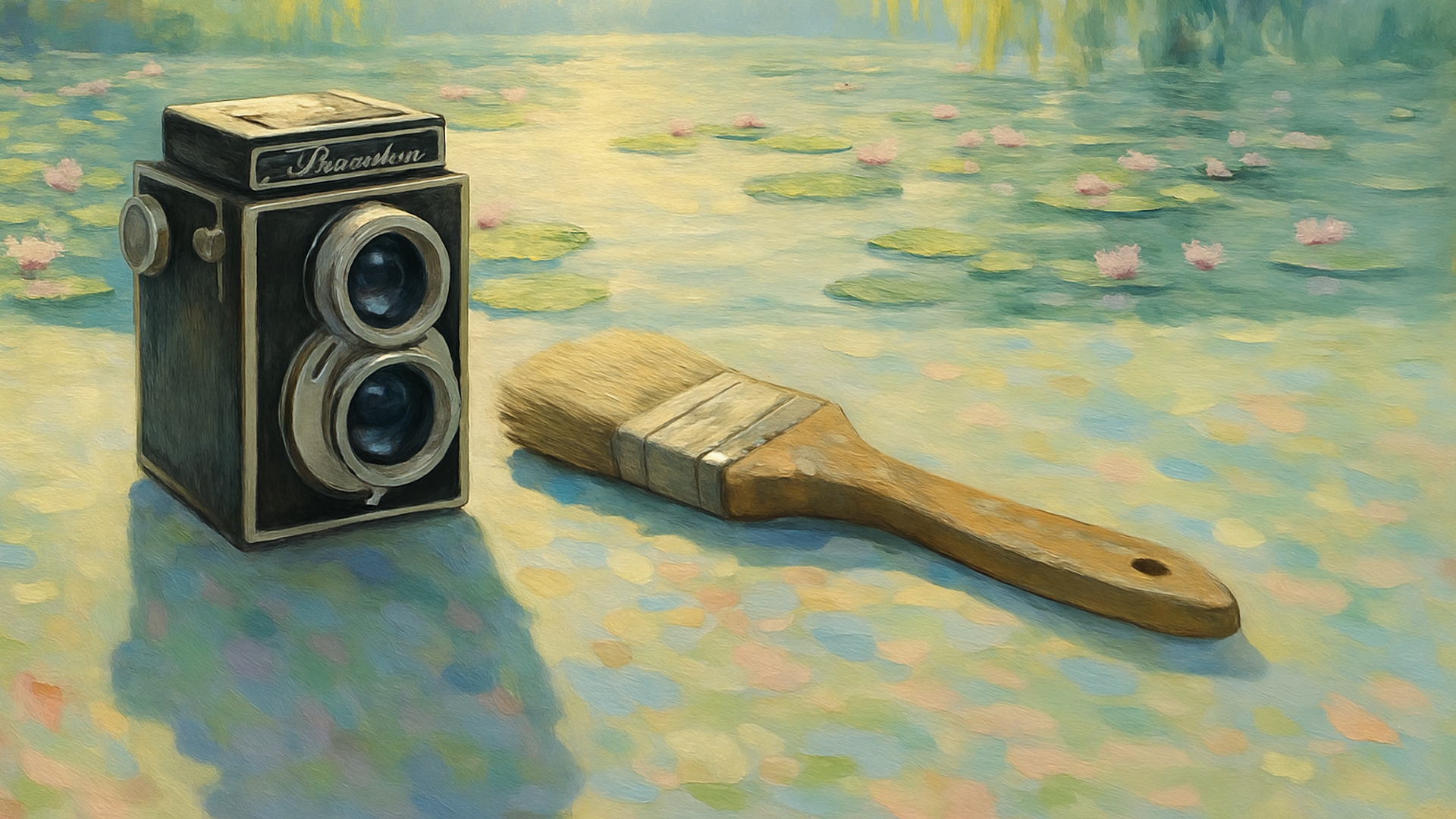
Every generation mistakes progress for purpose. Ours just automated it.
When the Camera Learned to See
And What It Tells Us About AI
A common pattern in engineering is what I call The Efficiency Mirage: the illusion that optimizing for one goal makes the whole system better. You focus so narrowly on what’s measurable that you achieve it, but at the expense of everything that isn’t. You hit the target, but miss the point.
We’ve seen this before.
In the 1970s, AI researchers believed that mastering chess would unlock the secrets of human intelligence. When IBM’s Deep Blue finally defeated Garry Kasparov, the world called it a triumph. It was. But it also revealed a sobering truth: building a machine that wins at chess told us nothing new about how humans think. We optimized the outcome, not the understanding. Again, we hit the target, but missed the point.
The Artist’s Panic
When Joseph Nicéphore Niépce produced the first permanent photograph in the 1820s, later perfected by Daguerre, painters, engravers, and portraitists felt the ground shift beneath them.
For centuries, their craft had been to capture reality. Suddenly, a machine could do it faster, more precisely, and at scale. Newspapers asked, “Will the painter become obsolete?”
Some artists panicked. Others dismissed photography as a “soulless trick of chemistry.” The French painter Paul Delaroche reportedly declared, “From today, painting is dead.”
But the best artists saw something different.
The impressionists, Monet, Degas, Cézanne, didn’t compete with the camera. They redefined what painting meant.
If photography could capture what the eye sees, painting would capture what the mind feels.
Photography freed artists from accuracy. It forced them into meaning.
In that sense, the invention of the camera didn’t kill art; it liberated it.
The Panic Returns
Every generation meets its own version of that moment.
Today, it’s not painters facing cameras. It’s designers, analysts, marketers, copywriters, and engineers, all staring at the lens of artificial intelligence and asking the same question: Will I become obsolete?
The panic feels justified. AI writes, codes, analyzes, and designs faster than any of us can. But just like in the 1800s, we’re mistaking the threat.
The danger isn’t that AI will do our jobs. The danger is that it will do them too literally perfectly, efficiently, and without context.
If photography captured the visible world, AI captures the logical one. What it misses is intent, judgment, intuition, the invisible human composition behind the work.
When the Boards Fire Us
The past two years have made this tension brutal and visible. Across the industry, tens of thousands of employees have been laid off as companies of every size, from global giants to emerging startups, announced “AI-driven restructurings.”
Executives frame it as transformation, efficiency, or progress. But let’s be honest: AI isn’t firing people. Boards are.
AI is the story that makes those decisions look visionary instead of extractive.
In truth, most organizations are still clumsy with AI. They’re replacing people before understanding the systems those people built. They’re chasing efficiency metrics while hollowing out the very knowledge that made them resilient.
It’s The Efficiency Mirage again: optimizing for a tool instead of a purpose.
The Human Fear Beneath the Layoffs
The fear goes deeper than job loss. It’s about erosion of meaning, skill, and agency.
Meaning erosion. If a machine replaces your role, what was the meaning in doing it?
Deskilling. As we hand off more work to automation, we risk atrophy, not because machines are smarter, but because we stop practicing our own thinking.
Trust and agency. When systems decide performance, promotions, or even layoffs, who do we appeal to?
Proximity guilt. When others are cut in the name of efficiency, survival starts to feel conditional.
These aren’t numbers on a quarterly report. They’re the silent weight inside every “AI-first” announcement, the emotional cost of progress that no KPI captures.
What the Painters Knew
When cameras emerged, painters thought their value was precision. They were wrong. Their value was perception, the ability to translate the world into feeling.
We’re standing in the same place now.
AI can replicate intelligence, but not intention. It can reproduce every note, word, or brushstroke, but not the reason they exist.
The professionals who survive this transition won’t compete with AI. They’ll design around it.
Writers will become editors of intelligence.
Designers will become curators of interpretation.
Leaders will become architects of context, deciding not just what gets done, but why.
Those who cling to precision will lose to machines.
Those who move toward purpose will define the next era.
A Warning for Boards and Founders
For those making the cuts, remember: human labor isn’t a variable to trim; it’s a feedback mechanism in your system.
When you measure efficiency without cohesion, motivation, or meaning, you’ve built a hollow metric.
Every “efficiency gain” achieved through layoffs burns unseen capital; trust, curiosity, and shared intelligence. Once those are gone, you’re not leading transformation; you’re dismantling the foundation that made transformation possible.
The Real Question
When the first camera learned to see, it forced artists to feel.
Now that machines can reason, will it force us to care?
Because this time, there’s no guarantee that meaning will find its way back on its own.
The real question is not what AI will replace, but what we will choose to protect.
Will we let intelligence become a substitute for intention, or will we rebuild purpose into the system before it’s too late?